A long time ago, before I even knew who Charles Eames (let alone JHQ) was, I had a guitar made for me by a college friend, Jake Savin. In a example of temporally disjoined hobby convergence, the woods we chose to use were the same woods used by JHQ in his rare woods series for Dansk. Funny that my love of this wood preceeded my interest in Danish Modern and flowed from my guitar playing. You can never tell how hobbies will flow into each other. Perhaps this explains a few things… I still recall going to the lumber yard and choosing the wood – especially the cocobolo – for its amazing grain and coloring. Wenge is actually quite popular in guitar building. Some info from Warmoth (who made the guitar’s birdseye maple neck) on these wood’s use in guitar body construction
Wenge features black and chocolate brown stripes. It is usually quartersawn to yield straight grain – similar to open grained Zebrawood, but black. This body is in the heavy weight category so considering it as a hollow or chambered build is beneficial if you’re weight conscious. Its weight does offer plenty of sustain though. Oil finishes are most popular on Wenge but you can also leave them unfinished as well. The tone is balanced with great mid presence and attack. This is a popular wood for boutique bass builders and its tonal reputation is impressive.
Here’s what they say about Cocobolo (I wish I knew this when I volunteered to sand the guitar):
A true Rosewood species and gorgeous to behold. Unfortunately this extremely oily wood is difficult to glue. Worse yet, the dust is very irritating and toxic. We have used it in the past but due to the allergic reactions we choose not to work with this wood.
The guitar is built of 5 layers. The “tone wood” core is of alder, sandwiched by a solid 1/4″ layer of book-matched wenge, covered with a 1/4″ thick cocobolo and wenge face. The construction is beautiful, with the tremolo cover, pickup mount, and control cover all made out of wood pieces integrated into the body.
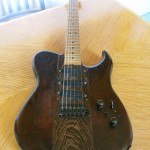
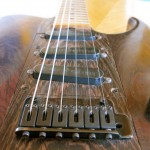
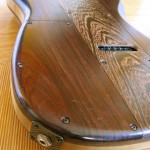
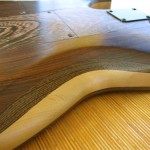
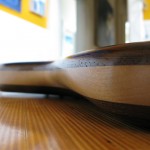
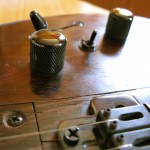
The guitar is beautiful and sounds great, but it is VERY heavy and my old back can’t support it anymore. Thus I am saying good-bye to it and turning it into a more traditional strat with an ultra light Fender body that I found. I took some photos of the Savin guitar to remember it in its glory, before I start tearing it apart. I hope you enjoy the photos, and I’ll post some of the new guitar when it is done.


I’m not familiar with guitars… are you transplanting the neck, pickups, etc. to a new body? What will you do with this one? eBay? 🙂
As one guitar player and grinder collector to another, I say don’t do it, Mark. You have something cool and rare there.
And you can buy a perfectly good MIM Standard Strat used off craigslist for $250 or less.
If there’s no rule against having 50+ pepper grinders, there’s certainly not one against having two single-coil guitars, especially when one is that unique and has that much history. You can play it sitting down.
Thanks for the comments!
Todd – Yes, I will unscrew all the parts, including the neck, pickups, bridge, and controls and install them in the new body. I’ll hire someone to deal with the electronics and do the final setup, but the rest of it should be possible with the amount of woodworking experience I have. Hopefully, all the parts should transfer right over. No idea what I’ll do with the old body. Maybe I’ll turn it into pepper mills 😉
Foppy – I understand what you are saying. It’s hard to part with it.
The thing is that the components on the guitar are some of the finest you can get. The neck and tuners are worth over $300, the pickups and pre-amp are hand made by Bartolini and would cost close to $400 to replace. Plus all the other parts… Although the body looks great, the playability and sound are what I love about it, and that is mostly related to the amazing neck and exotic pickups. This is going to be an instrument in a different league than a Mexican Strat. There’s also some intonation issues and neck slot issues that aren’t major, but do affect the guitar’s integrity.
Trust me – I don’t take this lightly (no pun intended). Of course, I could regret this whole thing. In that case I’ll just put all the parts back on the Savin body and be ready to rock – heavy style (pun intended).
Cool, Mark, seems like you’ve thoroughly thought this through–
It’s just that I’ve had some pretty powerful regrets over selling guitars in my life, especially unique ones.
One DOES need a strat of some kind, though. Shell pink, seafoam green, Lake Placid blue–it’s the mid-century modern design object par excellence!
Foppy – Tell me about it! I cry every time I look at how much 1972 Telecasters and late 70s Rickenbacker 330 12 strings are valued these days. I cry…
Yeah, I’ve never had a Strat, so I’m very excited about it. Thanks!!!
Speaking of custom guitar bodies, I stumbled across this in my day job: http://www.redeyerpm.com/CustomApplication.aspx Basically a couple of guitar players at a rapid prototyping company (like the one I work for) decided to make themselves elaborate guitar bodies on their prototyping equipment. I also saw a similar article here: http://architectradure.blogspot.com/2008/01/structural-innovation.html
[…] readers of my blog recently learned of the tonal qualities of wenge in musical instruments, I’m thinking I could make this one […]
yea, I agree with Foppy – you are crazy!
Are you crazy enough to build a pepper shaker into the new Fender guitar body?
Hey Mark, very, very long time, no see! 🙂
I stumbled across this doing a bit of ego-surfing on my PS3, and remembered this instrument fondly. I’m not sure if you know but Vance is still playing on (part of) one of the guitars I built for him. He baritone dropped a Modulus Graphite neck on it a few years ago, and has added and removed hex pickups more than once, I think, but it’s still getting played, which I love!
Anyway, I’m really hoping you haven’t dismantled her yet. My first thought was to buy this guitar off you, and then you can use the money to go buy a real strat. I might even be able to convince my dad the collector to trade you for a worthy instrument. I bet he’d be glad to preserve this little one-of-a-kind piece of my early creativity.
What say you?
Cheers, and nice to find you!
-Jake (Savin)
ps. We should catch up sometime. You can find me on Facebook, or email at me-at-jakesavin-dot-com.
[…] of my most popular posts was about the amazing guitar I had built in 1991 by Jake Savin and my plans to rebuild it into a more traditional Stratocaster […]