The October 2008 issue of Wallpaper magazine has a very nice article on JHQ. It has the basic bio on Quistgaard with a focus on on his relative anonymity in Denmark and his increasing attention from the design world at large – he’s finally getting “the glory he deserves.”
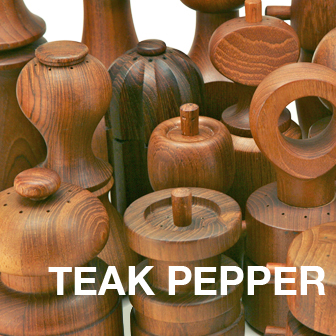
The best part of the article are the 5 photos taken in his home and studio. It includes a photo of his workshop, kitchen, pepper mill collection, teak collection, and archives. There’s some anecdotes from his children and stories about his business partnership with Dansk. The article also goes into some of the recent high prices his pieces have been getting at auction, as well as efforts to re-release some of his designs.
There are a few inaccuracies in the article and strangely there’s no photo of Jens himself. But overall, it’s a great mention in a highly prestigious international magazine. Too bad they didn’t mention my Danish Pepper book – I guess that’s what you get for self-publishing – and I can’t fire my publicist.
Thanks to Bob for the heads up.


Having tracked down this issue of Wallpaper* (thanks to a jobber who took the first cover but left two more for the store), I’ve read the article with interest. Now I’m curious. What are the “few inaccuracies.” Thanks for the clarification.
Hi Diane
Here’s the “few inaccuracies” I found in this otherwise excellent article.
– In the table of contents, Kongo is captioned as Fjord cutlery.
– On p 131, it says that a plastic version of Toke was released in the late 60s. I have never seen that, so I think they have it confused with Kongo – which is the plastic version of Fjord. Kongo came out in the late 50s, not the late 60s. If there is a plastic version of Toke, I’d love to see it.
– The article says that Dansk started to use other designers in the 80s, when in fact it had been using other designers since the mid 60s. I don’t know if this means the rift between JHQ and Ted Nierenberg the article speaks of started that early, or if it escalated in the 80s for related reasons.