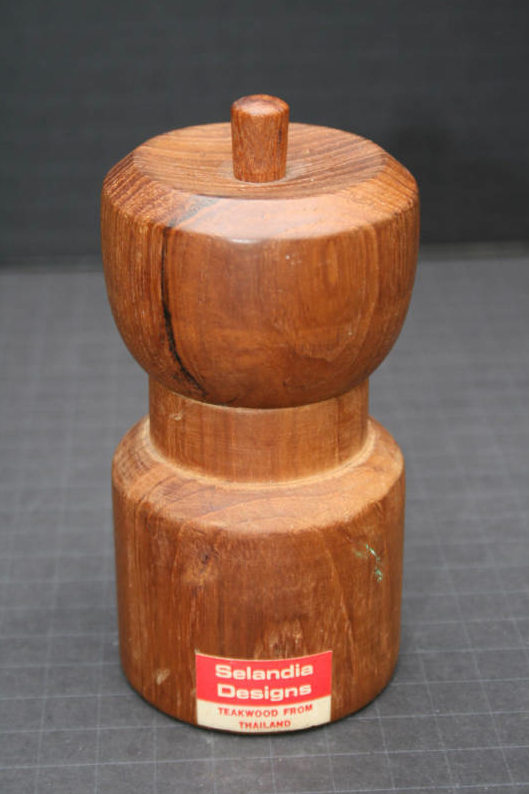
One mill in my collection has been a mystery ever since I first saw it in real life. It seems to be a real Quistgaard designed Dansk mill, but there are a few strange things about it.
First of all, the wood grain is somewhat different than most Dansk mills. It does not feel like the nice teak Dansk used. It’s teak, but the grain is not as straight and not as fine. Perhaps it is not old growth teak. The grain of the top portion doesn’t match the bottom as well as it should, either.
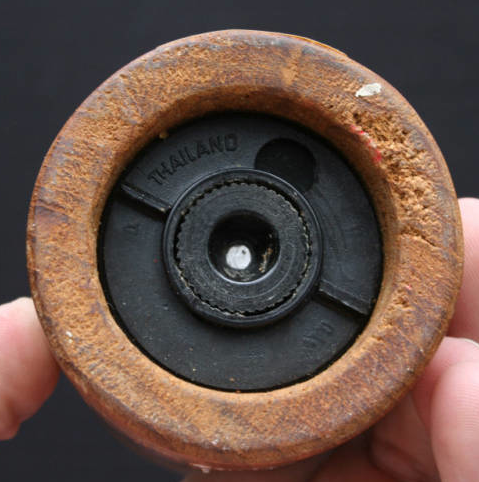
Second, the grinders look exactly like the grinders Dansk used during its run when it produced mills in Thailand, but all of the writing on the plastic has seemingly been sanded off – except the word Thailand. Perhaps someone in Thailand bought a bunch of Dansk grinders off the back of a truck and went into production for themselves after grinding off the brand?
Third, although the design is quite good, it never felt exactly like a JHQ design. The scale and heft is right, but it’s not quite as refined and the quality is just a bit off. That plug in the top sure looks right. However, the way the top meets the bottom is not how JHQ did it. Either the seam is hidden in some way by the contour of the wood or it is accentuated by a small bevel on each piece. The top of this mill just sits on the bottom.
Fourth, the finish on the bottom is quite rough. Most Dansk mills are finished equally fine on both the top and the bottom.
Lastly, most of the mills from that era are quite common – this one seems quite rare.
Today there was a new listing for the mill on eBay which has solved the mystery. This mill clearly has a label which reads “Selandia Designs – Teakwood from Thailand”. Selandia is a Danish company that made teak and stainless steel accessories, similar to Dansk, but probably a bit later in the era – perhaps in the 70s judging from some of the packaging I’ve seen. It’s usually pretty good stuff, but much more utilitarian and not the quality of Dansk.
The mill is quite nice, but it it’s Dansk. The good news is that the mystery is solved. The bad news is that I have identified it as a Quistgaard mill in my book. It is in one of the illustrations, and in my defense, I had only seen poor photos of the mill at the time and was not aware of most of these issues. I’ve found a few errors in the book, and will surely correct them if I do another edition.


hi mark , im trying to get in touch w/you to first thank you for the nice blog and also to question you about the mushroom mills on pg. 95 of your book- i have 4 of the 5 pictured and need to know how to remove the entire top of the one , NOT pictured-looking forward to hearing from you , george
I’m not Mark, but the one that isn’t pictured on page 95 is what I call a “tooth fill” — you have to pull the halves apart. I’d advise against that, though, since two of the teeth on one of mine broke off while doing it. Pulling them apart is very tough, and I imagine that to have the best chance of not damaging the mechanism is to pull them straight apart, not angling one side up…
Here’s my page describing it (with a picture of the mill that lost some teeth):
http://www.tpederzani.com/pepper/Tooth_fill
I’m not sure if the plastic has aged, or the design just wasn’t that sound in the first place, but although it’s creative, that peppercorn fill mechanism just doesn’t work that well now.