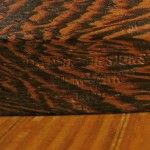
The Jens Quistgaard Wenge Rare Woods tray I won on eBay has arrived. I mentioned it at the end of an earlier post due to the low low price I paid for it, so I wanted to follow up. It is one of the few JHQ Dansk pieces that is signed on the edge of the tray – the signature is VERY hard to see unless you hold it up to the light. Wenge has such an open grain that you can’t even feel the signature by running your finger around it.
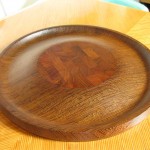
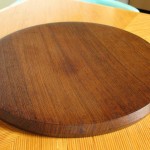
The tray is about 15″ round. The reason it is signed on the edge is that it is meant to be a two sided tray. One side has an end-grain teak cutting board, the other has an ever so gracefully concave surface – just enough to keep your food from flying off the edge. I have posted a photo of the back and you can just kind of see the curving surface. There are some splits in the end grain, but they are not bad enough to cause structural damage to the piece (it probably had water sitting on it during a dinner party). The discoloration you see towards the center on the “back” side is from a quick and dirty mineral oil application – I’m pretty sure I can bring it back to pristine condition with a little elbow grease.
This piece is not included in any documentation I have seen on the Rare Woods series, so I am wondering when it was created. I think it might have been done alongside the squat wenge ice bucket that has a handle, but I don’t know if that was in the circa 1962 era of the rest of the line, or if there was more than one wave of rare woods pieces.
Since readers of my blog recently learned of the tonal qualities of wenge in musical instruments, I’m thinking I could make this one into a cool banjo…


Very nice. I haven’t looked over what I have available to me, and I don’t see it either. All I have shows 1601 – 1606 being Wenge, but nothing else.
So the tray says “Dansk Designs / Denmark / JHQ”? That is the same set of markings that some of the peppermills with the Tre Spade mechanism have. I wonder if they’re from the same era? If so, that might help.